I’m not a religious person. As such, I have wondered how people historically came to be religious. I’m sure there are many reasons which can be dated back thousands of years, probably starting with the worship of the sun and moon, water sources, nature and anything that provided life and security.
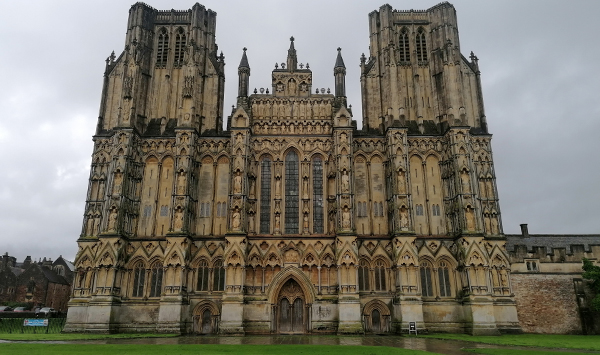
A story I want to touch upon is one I heard while visiting Wells Cathedral (a must-visit for anyone interested in medieval architecture or cathedrals):
Cast your mind and imagination back a few hundred years. You are a peasant working a field owned by someone else. You have very little to your name and most likely work long hours every day of the week. Taking a break could lead to a significant loss in your livelihood.
Your entire existence is centred around the small community you live and work with. Perhaps, once in a while, you’re lucky to meet someone travelling from another town, village or city. You know larger settlements exist but you’ve never travelled to them. Merchants bring any goods you may need to trade.
You know of a great procession that marches towards your nearest cathedral, though you have never been a part of it nor seen signs of it. Now is the time to express your devotion to God – He who has given so much to you and your family, after all, you have land to work and food to eat. Things could be much worse. So you make a request to your landowner to permit you to take some days off work and join the procession – a once-in-a-lifetime experience.
On your journey, you gradually encounter more and more people who are making their way to the start. There are more people than you have ever seen before. Your eyes are amazed at the sight and can hardly believe what they are seeing. You know you are a part of something special, even if you can’t quite grasp what it is.
Eventually, there is a whole mass of people marching orderly towards a common purpose. Some of them are holding flags or banners above the crowd. From the front of the procession a wave of awe slowly works its way back toward you. As you look up to see where the reaction is originating, you see a distant building made entirely of stone – the cathedral.
The tallest buildings you had previously seen were a few barns, a farmhouse and the local church. The cathedral is beyond the height of any of those; a giant stone facade, intricately carved and painted. You start to think, ‘This must be the work of God‘. After all, what or who else could create such wonder at this magnitude.
The building looms ever larger; towering into the sky. A chorus echoes quietly from the cathedral’s stonework, growing louder with each step – the angels on the facade are singing at the procession. The angels of God are welcoming you.
You walk through the towering doors into the cathedral’s nave surrounded by hundreds of people from all the neighbouring farms, villages and towns. This is a moment you will never forget nor fully understand. After the ceremony and celebrations the crowds begin to disperse. You travel back to the farm to work with boosted morale and vigour. Your faith is cemented. God truly is almighty.
This story truly gripped me and opened my eyes to what people hundreds of years ago must have felt when witnessing the crowds and the cathedral for the first time. It’s all too easy to take our current world for granted. Living on the edge of London, everywhere I look buildings far bigger than cathedrals in height and land area exist.
Of course, the singing angels were not real. The cathedral had holes in the stonework near the top where choir boys would stand and sing out. This gave the illusion of a supernatural occurrence for the benefit of those below.
The priests inside knew all too well the charade they were creating. This was of a time when the church had great power; much more than it possesses today. This power needed to be held onto to ensure control over local people and riches for the church.
 Visually Interesting
Leave a comment